


Women have influenced modern technology for generations, yet historically, STEM fields have been male-dominated spaces with little visibility or focus on the game-changing impact of women in the field.
That gap matters! When their stories aren't told, students lose examples, industries lose context, and the public gets an incomplete picture of how innovation actually happens.
Read about the powerful contributions of eight women in tech over time and their impact on the industry. They can serve as a blueprint for overcoming systemic challenges and keeping their stories alive to inspire generations to come.
Why Telling Their Stories Matters
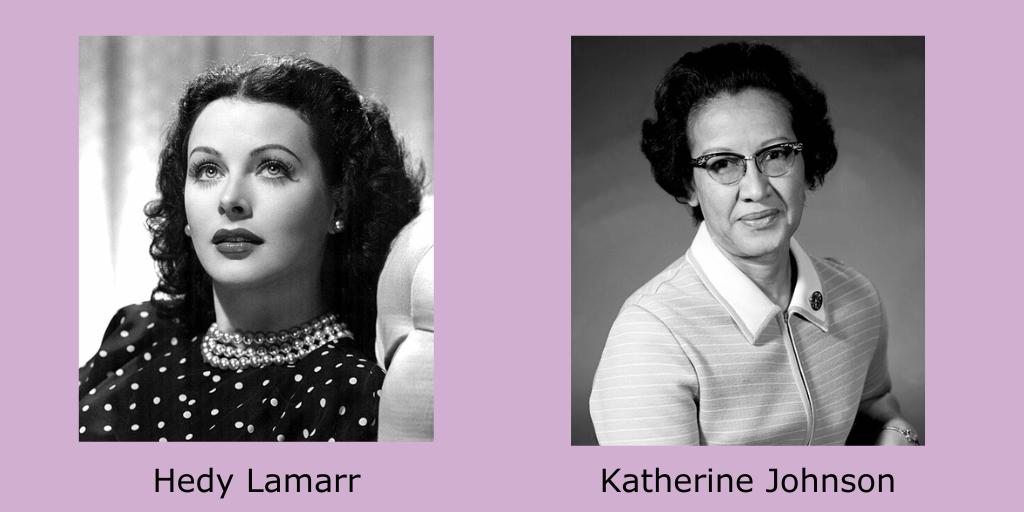
Did you know that actress Hedy Lamarr was the inventor of the basis for wi-fi, GPS, and Bluetooth communication systems? Or that the person who calculated the trajectory for astronaut Alan Shepherd, the first American in space, was a Black mathematician and computer scientist named Katherine Johnson ?
Women have always participated in science and engineering; the issue isn't contribution, it's visibility.
Sharing this history important because seeing what women can and have achieved encourages the generations to come to pursue careers in STEM fields. Without role models, the misconception that technology is "not for women" lingers. When we share their stories, we're helping create a more inclusive and balanced industry, as well as demonstrating what is possible!
Telling women's stories in tech isn't just feel-good content; it does real work:
- It Challenges Outdated Stereotypes - STEM was never just for men. Breaking up with the outdated idea that men are "better" at STEM subjects by showcasing women who helped build the industry offers proof, not just an argument.
- It Gives Young Women Something to Aim For - Seeing real examples of success in STEM helps bridge the gap in STEM education and careers for girls and women.
- It Corrects the Record - Taking the time and effort to recognize and celebrate women's contributions to the field isn't revisionist history or trendy. It's providing an accurate history.
- It Builds Courage - Knowing other women faced resistance and kept going anyway is inspiring and helps pave the way for the next generation to do the same.
History's Female Tech Trailblazers
We mentioned Hedy Lamarr and Katherine Johnson, both incredibly important women in the progress of tech in the 20th century. These women were swimming upstream in a powerful current of patriarchy, sexism, racism, negative stereotypes, and systemic barriers to their achievement in the field, as diversity in tech fields barely existed. Yet, they persisted despite these strong headwinds threatening to knock them off their moorings. Some additional women whose contributions to the advancement of technology in society include:
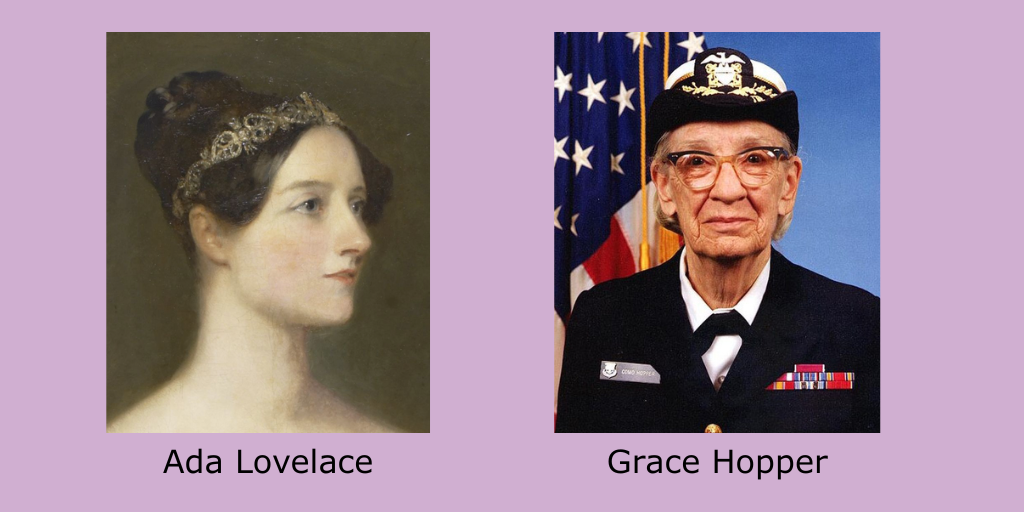
Ada Lovelace
An English mathematician, Ada Lovelace is largely regarded as the first computer programmer. Her friend and collaborator, Charles Babbage, designed the Analytical Engine. Lovelace was translating an article about it written by Luigi Menabrea. She added extensive notes (nearly three times longer than the original article) that included a detailed explanation of how it could be used for more than just calculations. Her notes included a description of how it could compose music and manipulate symbols. She had a unique ability to use pattern-based poetic language to describe mathematical insights, often referred to as "poetical science," and saw the potential for how people and society can relate to technology as a collaborative tool.
Grace Hopper
American computer scientist, mathematician, and U.S. Navy Rear Admiral, Grace Hopper was a vanguard of computer programming. She was the first person to formulate the theory of machine-independent programming languages. She applied this theory to develop the FLOW-MATIC programming language, a direct precursor and major influence on the development of COBOL - a language still in use today. She championed COBOL's adoption, overseeing the development of one of the first COBOL compilers. Her compiler converted English terms into machine code understood by computers, which continues to shape how computers are programmed today.
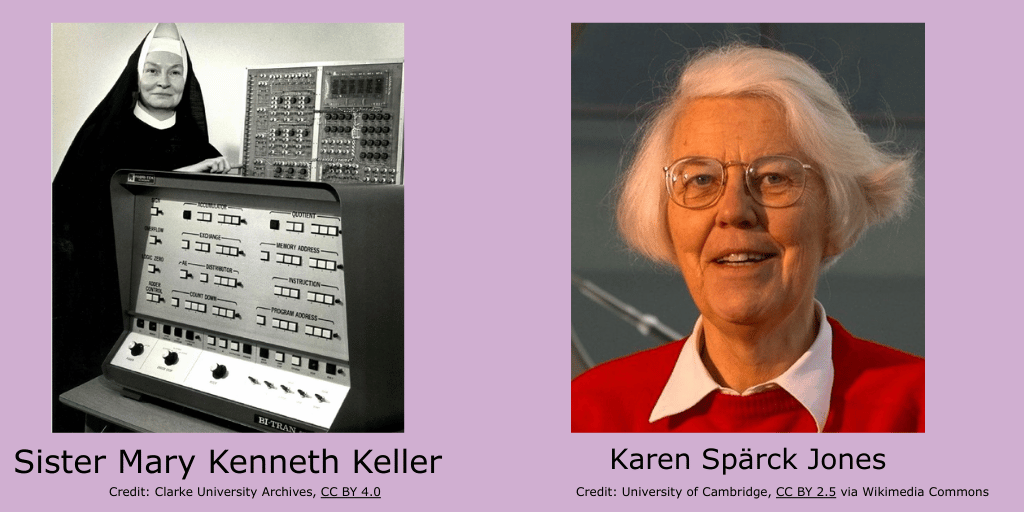
Sister Mary Kenneth Keller
Sister Mary Kenneth Keller was the first woman in the United States to earn a PhD in computer science and played a large role in the development of the BASIC computer programming language. A strong advocate for women's involvement in computing, Sister Keller believed in the potential for computers to promote education by way of increasing access to information. She founded the computer science department at Clarke College (now Clarke University), wrote several books on the field, and helped establish the Association of Small Computer Users in Education (ASCUE) .
Karen Spärck Jones
Karen Spärck Jones was a British self-taught programmer, computer, and information scientist. Her work integrating statistics and linguistics paved the way for developments in the fields of information retrieval and natural language processing. While working on information retrieval (IR) she decided to incorporate linguistics, embarking on a project to transcribe Roger's Thesaurus onto punch cards. This led the way to her pioneering the technology called 'inverse document frequency' (IDF) in 1972, that, when combined with 'term frequency' (TF), laid the groundwork for modern search engines.
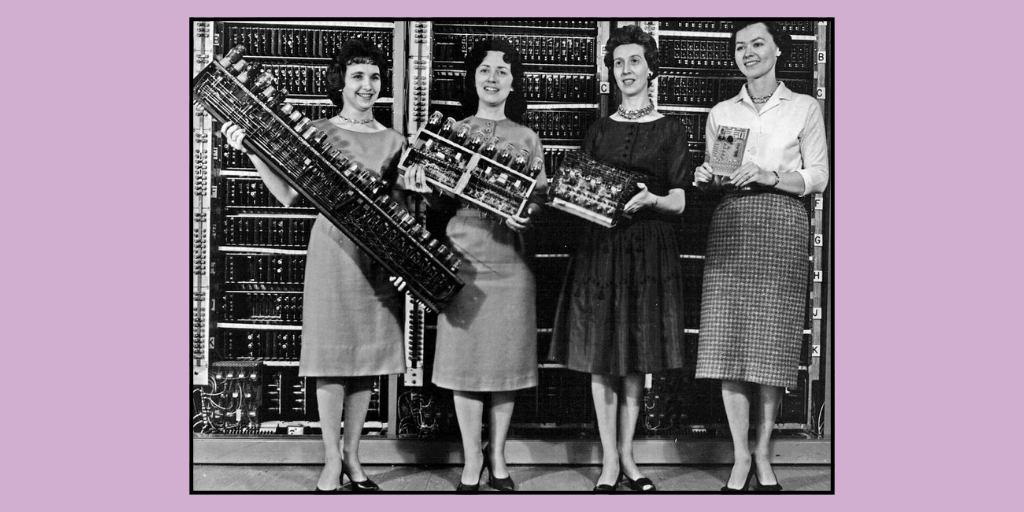
The ENIAC Programmers
The ENIAC (Electronic Numerical Integrator and Computer) was the first general purpose electronic digital computer, created to calculate ballistics trajectories for the Army's Ballistic Research Laboratory in 1945. It was primarily programmed by six women: Kay McNulty, Betty Jennings, Betty Snyder, Marlyn Wescoff, Fran Bilas, and Ruth Lichterman. The women were handed wiring and logical diagrams of the machine and then instructed to 'figure it out.' They successfully calculated and programmed the massive machine, changing the trajectory of computer science forever.
Their contributions were nearly lost to history due to the prevailing attitudes surrounding women in technology fields at the time and the novelty of computer programming. Thanks to Kathy Kleiman , an early contributor to ICANN domain name policy work, the women's stories were rediscovered and celebrated. Ms. Kleiman founded the ENIAC Programmers Project .

Annie Easley
Annie Easley was an African American computer scientist and mathematician who made significant, mission-critical contributions to NASA's rocket systems and energy technologies. Her work included the Centaur Project, which helped build the technological foundations for the space shuttle launches, as well as communication, military, and weather satellite launches.
As one of three African American women employed at NASA, Annie Easley faced a particularly difficult career journey , often facing blatant discrimination because of her race and gender. She famously stated, "My head is not in the sand. But my thing is, if I can't work with you, I will work around you. I was not about to be so discouraged that I'd walk away." Despite the obstacles, she pressed on, doing the work she was confident she had the ability to do and advocating for young female and minority students in college to work in STEM fields.
Ginni Rometty
Ginni Rometty is the first woman CEO of IBM, leading the legacy tech company from 2012 to 2020. She began her career there in 1981, rising through the ranks to eventually take the helm as Chairman, President, and CEO . Ginni Rometty navigated the company through a major market repositioning, equipping the legacy tech company for the future with smart investments and portfolio changes, including deep investment in enterprise cloud-based solutions and AI. "She made bold changes to reposition IBM for the future, reinventing 50% of the company's portfolio." (Hank Paulson, 74th US Treasury Secretary and Chairman of the Paulson Institute)
Keeping the Entire History Alive is Important
Sharing the stories of women who have pushed through barriers in STEM fields does more than inspire; it plants the seeds for real systemic change. When women see themselves reflected in others' success, something shifts. Research consistently shows that representation matters. Girls and women who have access to role models in STEM are more likely to pursue those paths themselves.
That ripple effect looks like this in practice:
- More Women Pursuing STEM Education - Seeing someone who looks like you succeed in a technical field build confidence in ways that textbooks alone simply can't.
- More Women Entering Tech Careers - Seeing that others have navigated (and survived!) similar challenges and overcome them helps reduce the fear of being the "only woman in the room."
- More Women Leading and Innovating - Role models don't just open doors - they give examples to inspire and encourage women to make their own mark on the industry.
The Role of Media and Education in Storytelling
The way we tell stories matters! Media, educational curricula, and professional networks play a big role in shaping public opinion and inspiring future generations. Strategies for amplifying the stories of women in STEM include:
- Incorporating Women's Contributions into STEM Education - Ensuring that curriculums in school highlight the work of female scientists, engineers, and tech leaders so students get a full picture of who built the field.
- Promoting Visibility in Media and Conferences - Featuring women in tech at industry events, interviews, and panels to normalize their experience.
- Encouraging Mentorship and Networking - Creating opportunities for women to connect. share their experiences, and support each other in their professional journeys.
- Leveraging Digital Platforms - Blogs, podcasts, and social media are all venues for sharing the inspiring stories about women in tech that might otherwise go untold.
"What's Up With Chicks and Science?"
You may have noticed that here at EventBuilder, we're deeply passionate about lifting the voices of women in STEM fields and telling their stories. We think this anecdote illustrates perfectly the reason why:
In 2014, Neil deGrasse Tyson was filmed at a lecture panel responding to a question posed by former Treasury Secretary and Harvard University President Lawrence Summers. Summers suggested that genetic differences could explain why there are fewer girls in science, asking, "What's up with chicks and science?" deGrasse Tyson fielded the comment , sharing his experience as a Black astrophysicist in a white male-dominated field. Calling his ambition to be a scientist "the path of most resistance" and drawing parallels from his journey to that of women who pursue STEM careers, he asks the question, "What is the blood on the tracks that I happened to survive that others did not simply because of the forces of society that prevented at every turn?" deGrasse Tyson stated, "...my life experience tells me that when you don't find Blacks in the field, you don't find women in the sciences. I know that these forces are real and I had to survive them to get where I am today. So before we start talking about genetic differences, you've got to come up with a system where there's equal opportunity. Then we can have that conversation."
We wholeheartedly agree.
Building a Future of Inclusion and Innovation
At EventBuilder, we believe in the power of storytelling to bring about meaningful change. The stories of women in STEM aren't just part of history, they're a roadmap for the future. The more we celebrate the achievements of women in STEM, the more we pave the way for a more diverse, inclusive, and innovative industry. We're committed to elevate the voices of women in STEM by:
- Hosting Virtual Events - Providing spaces to celebrate the achievements of women in technology through webinars and panel discussions.
- Featuring Inspirational Speakers - Showcasing women who have made an impact in STEM fields to serve as role models for the next generation.
- Building Community Networks - Creating opportunities for women in tech to connect, share knowledge, and support each other.
- Amplifying Visibility - Using digital events to highlight achievements, giving women in tech a place to receive the recognition they so richly deserve.
Let's continue to elevate the voices of women in STEM and make certain that their contributions to technology and other STEM fields don't fade away into history!
FAQ
Why is women in STEM history important?
Women have always played key roles in computing, engineering, aerospace, and communications. Recognizing their contributions provides a more accurate history and helps encourage broader participation in technical fields.
Who is considered the first computer programmer?
Many historians identify Ada Lovelace as the first computer programmer because she described how instructions could be written for Charles Babbage's Analytical Engine. (Source: Computer History Museum )
Did Hedy Lamarr Invent Wi-Fi?
No, she co-invented a communication system in the 1940's called "frequency-hopping." The concept later contributed to the spread-spectrum technology we use in our wireless systems. She was inducted into the National Inventors Hall of Fame in 2014, leading her to be dubbed "the mother of Wi-Fi(Source: The Women's History Museum )
How can events support women in STEM?
Events can support women in STEM by featuring women experts as speakers, highlighting historical contributions, creating mentorship opportunities, and sharing educational content.
EventBuilder Leads the Way
Learn about how EventBuilder, a 100% women owned and led company offering enterprise event management services, is making a difference. You can attend our events, or connect with us to see how we can help support your commitment to amplify the work of women in STEM!
Disclaimer: This article was created with some help from AI, but thoroughly edited, revised, reviewed, and fact-checked by a living, breathing, coffee-drinking human writer.
Building a Supportive Network: Tips For Women in Tech
Shattering Stereotypes: Debunking Myths About Women in Tech
No Comments Yet
Let us know what you think